
News

Choosing the right engine oil is one of the factors that directly affects the durability, reliability, and operating costs of trucks. TotalEnergies offers two product lines—Rubia TIR and Rubia Optima—that meet the needs of fleets with diverse vehicle structures and ages. How do these series differ, and when should you choose each one?
TotalEnergies offers heavy-duty engine oils with over 200 engine manufacturer approvals, which in practice means the ability to precisely select a product for both modern engines and older models used in road transport, construction, and agriculture. The right oil can be selected based on the engine manufacturer’s approval. In situations requiring a customized selection, it’s important to understand the differences between the Rubia TIR and Rubia Optima lines.
TotalEnergies Rubia TIR – Proven Technology for Older Fleets
Rubia TIR is a line of older-generation oils that has been one of the cornerstones of TotalEnergies’ heavy-duty transport offering for years. Products in this range are approved by most engine manufacturers for emission classes ranging from EURO III to EURO VI, ensuring they remain widely used in many fleets.
This range is often chosen by carriers operating older vehicles. The oils utilize Pro-Efficient technology, developed by TotalEnergies’ research and development teams, which aims to reduce mechanical engine wear and extend oil change intervals.
Among the benefits of using Rubia TIR oils with Pro-Efficient technology are extended engine life, lower maintenance costs, reduced oil consumption, and effective protection of mating surfaces.
The additive technology used in Rubia TIR products forms a durable protective film on the engine’s metal components, minimizing direct contact between moving parts. Additionally, viscosity modifiers help maintain a stable oil film even at high temperatures and under heavy loads.
The effectiveness of this technology has been confirmed in laboratory tests. For example, tests conducted on an OM 646LA engine showed up to 81% less mechanical wear compared to the requirements of the ACEA E4 standard (regarding wear on the exhaust valve camshaft cams when using Rubia TIR 9200 FE 5W-30 oil).
TotalEnergies Rubia Optima – the answer to the demands of modern engines
The Rubia Optima line was developed in response to the rapid advancement of technologies used in modern truck engines. Although it was designed with the latest vehicles in mind, it can also be successfully used in older models, allowing fleets to standardize the oil they use. This means that Rubia Optima can, in most cases, replace oils from the Rubia TIR line, whereas the reverse—using older oils in modern engines—is not recommended.
Why was Rubia Optima developed?
Modern truck engines are characterized by lower fuel consumption, smaller displacement while maintaining high power, significantly extended service intervals, and advanced exhaust aftertreatment systems. These design changes necessitated the development of a completely new generation of engine oils capable of operating under conditions of increased thermal and mechanical loads. Rubia Optima was developed through a collaboration between TotalEnergies and engine manufacturers. It meets the latest API CK-4 and ACEA E8 and E11 quality requirements.
Oils in this line are compatible with DPF and SCR systems as well as with fuels containing bio-components, which is crucial for the durability of exhaust aftertreatment systems and the stability of oil performance during operation.
Inno-Boost Technology in Rubia Optima Oils
Products in the Rubia Optima range utilize Inno-Boost technology, based on advanced base oils and modern additive packages. As a result, they meet, among other things:
stricter requirements regarding the protection of cylinder liners and piston rings against wear, piston cleanliness, ring seizure, sludge, and deposits in engines when using fuel with a higher biofuel content, as well as increased soot levels; this results in better compatibility and greater dispersion, stricter requirements regarding oil viscosity loss due to polymer shear and oil aeration, and heightened requirements for protection against DPF clogging.
Rubia Optima 3500 FE 5W-30
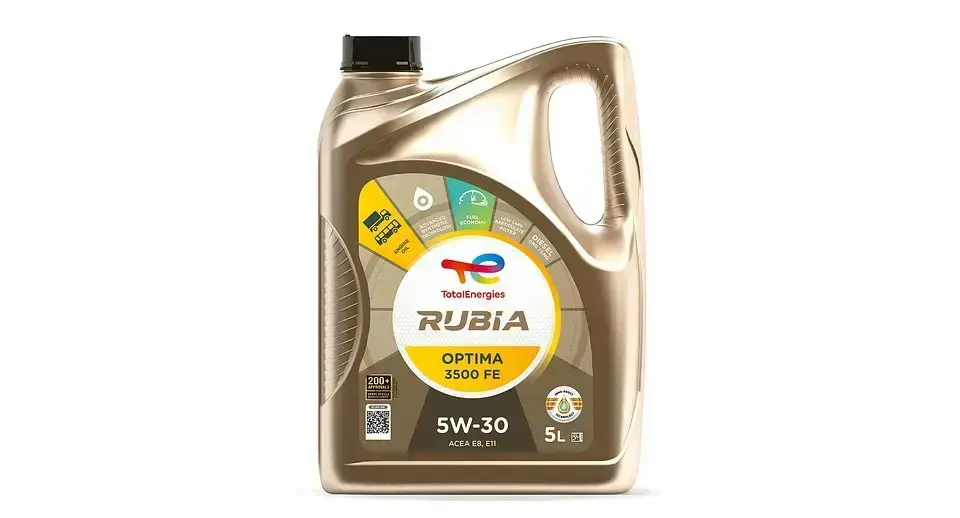
An example of a solution developed with modern powertrains in mind is TotalEnergies Rubia Optima 3500 FE 5W-30. This fully synthetic, Low SAPS product meets the requirements of the latest API CK-4 standard and is designed for most trucks and buses that comply with Euro 6 emissions standards.
This oil is designed for the latest generation of diesel engines equipped with exhaust aftertreatment systems (DPF and catalytic converter), and is also compatible with select natural gas engines. Its suitability is confirmed by approvals from manufacturers such as MAN M 3677 and Scania LDF-4.
Summary
The Rubia TIR and Rubia Optima lines address the diverse needs of truck fleets—from older models to the latest vehicles meeting stricter emissions standards. Engine manufacturers’ approvals and vehicle operating conditions remain key to selecting the right oil.