
News

TotalEnergies coolants not only protect the system from freezing, but above all protect it from corrosion and component degradation. The company's experts, Andrzej Husiatyński and Adam Klimek, explain what makes them so effective and conduct an experiment that demonstrates the differences between water, glycol, and TotalEnergies professional coolant in practice.
Why can't we protect the engine with water alone?
Most drivers know that pure water in the cooling system in winter can damage the engine. However, freezing is only one of several problems. A cooling system with a capacity of approx. 8-10 liters must constantly dissipate excess heat energy, which modern engines generate in large quantities.
Water, although an excellent heat conductor, also has its drawbacks. Among the most important of these are its high freezing point, low boiling point, and excellent electrolytic conductivity, which promotes corrosion.
Typical causes of cooling system damage include corrosion, cavitation that adversely affects pumps and seals, overheating, deposits, and degradation of hoses due to hardening. Pure water, even demineralized water, does not prevent any of these phenomena.
Why is glycol not a solution either?

Ethylene glycol is most commonly used to lower the freezing point, but it also does not meet the requirements of a cooling system. Pure glycol conducts heat less efficiently than water, freezes at -13°C, and does not protect against corrosion on its own.
Only a mixture of glycol and deionized water (1:1) provides optimal parameters: a freezing point of -37°C, a boiling point of 108°C, and optimal heat dissipation. However, even this solution still does not protect the system against corrosion, deposits, or material degradation.
OAT technology – the key to effective protection

Modern TotalEnergies coolants use OAT (Organic Additive Technology), based on organic corrosion inhibitors.
They ensure:
- deactivation of metal cations,
- stopping of corrosion processes,
- protection of components made of copper, brass, aluminum, and steel,
- no deposits and long-term chemical stability.
Importantly, the protective inhibitor layer formed inside the system is extremely thin, so it does not restrict heat dissipation. TotalEnergies also ensures the highest quality of the glycol used. Cheap, low-quality glycols can oxidize and produce acidic compounds that accelerate corrosion instead of preventing it.
TotalEnergies experiment
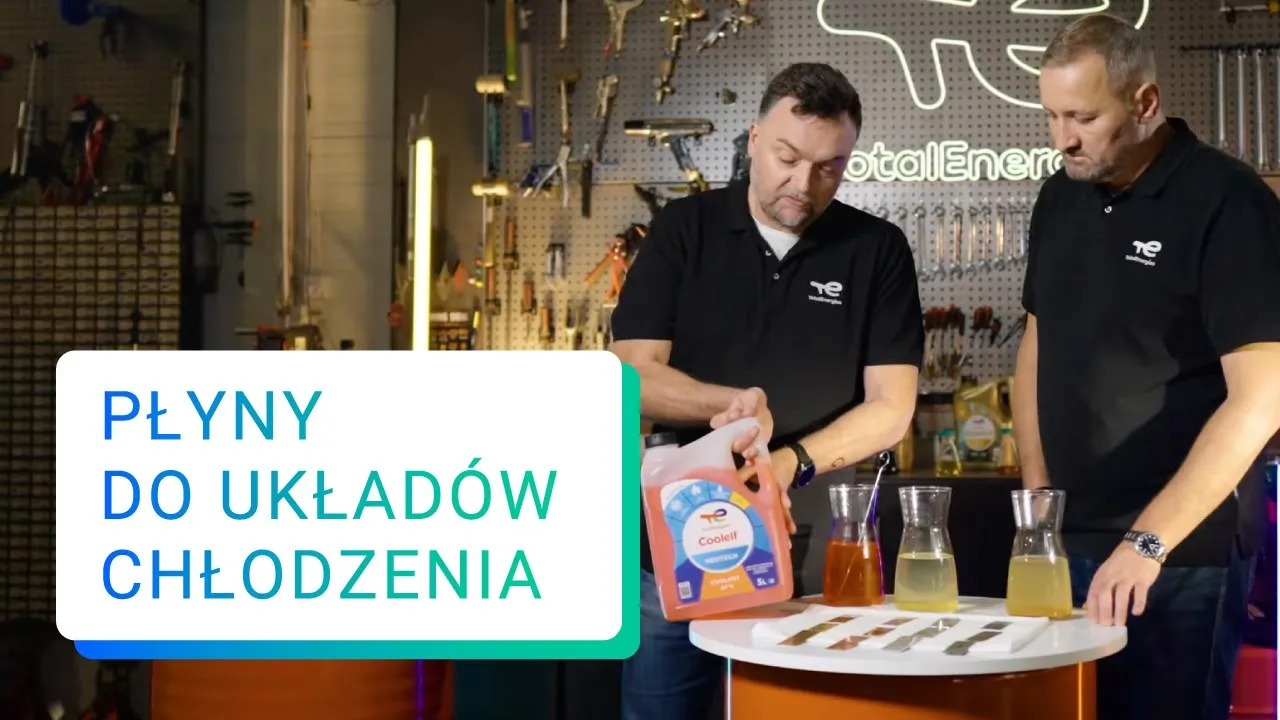
To illustrate the differences, TotalEnergies experts Andrzej Husiatyński and Adam Klimek conducted a practical test.
They prepared three vessels:
1. with clean water,
2. with pure glycol,
3. with TotalEnergies coolant.
Four identical plates made of copper, brass, aluminum, and steel were placed in each container. Salt was added to the solutions to accelerate the corrosion processes.
After a week, the following effects were observed:
- water – intense corrosion on all metals; sediment covering the entire bottom of the container,
- glycol – less severe, but still noticeable corrosion; sediment was also present,
- TotalEnergies fluid – no corrosion, no sediment.
The results of the experiment are clear. The video is available for viewing at the following link:
TotalEnergies coolants – a wide range of products
TotalEnergies offers both ready-to-use coolants and concentrates for self-dilution. The most popular ready-to-use fluids are Coolelf Neotech and Coolelf Plus Evo (also for electric vehicles), while the most popular concentrates are Glacelf Cartech and Glacelf Neotech. These products provide complete protection for modern cooling systems.